PROJECT / SMART-TRAFFIC
AI-driven Smart Urban Traffic Management System
An AI-assisted traffic command center that combines congestion classification, short-horizon demand forecasting, adaptive signal planning, traffic simulation, and model-based environmental analysis.
01 / PROBLEM
Urban congestion can increase travel delay, vehicle idle time, fuel use, and vehicle-related environmental impact. Static dashboards alone do not show how a traffic prediction can inform a decision or how that decision might perform under controlled conditions.
02 / APPROACH
An academic decision-support prototype that follows an Observe → Predict → Decide → Simulate → Measure workflow. It turns predicted congestion and demand into bounded signal-timing recommendations, then compares an AI-assisted strategy with a fixed-time baseline in a simulated traffic network.
03 / KEY FEATURES
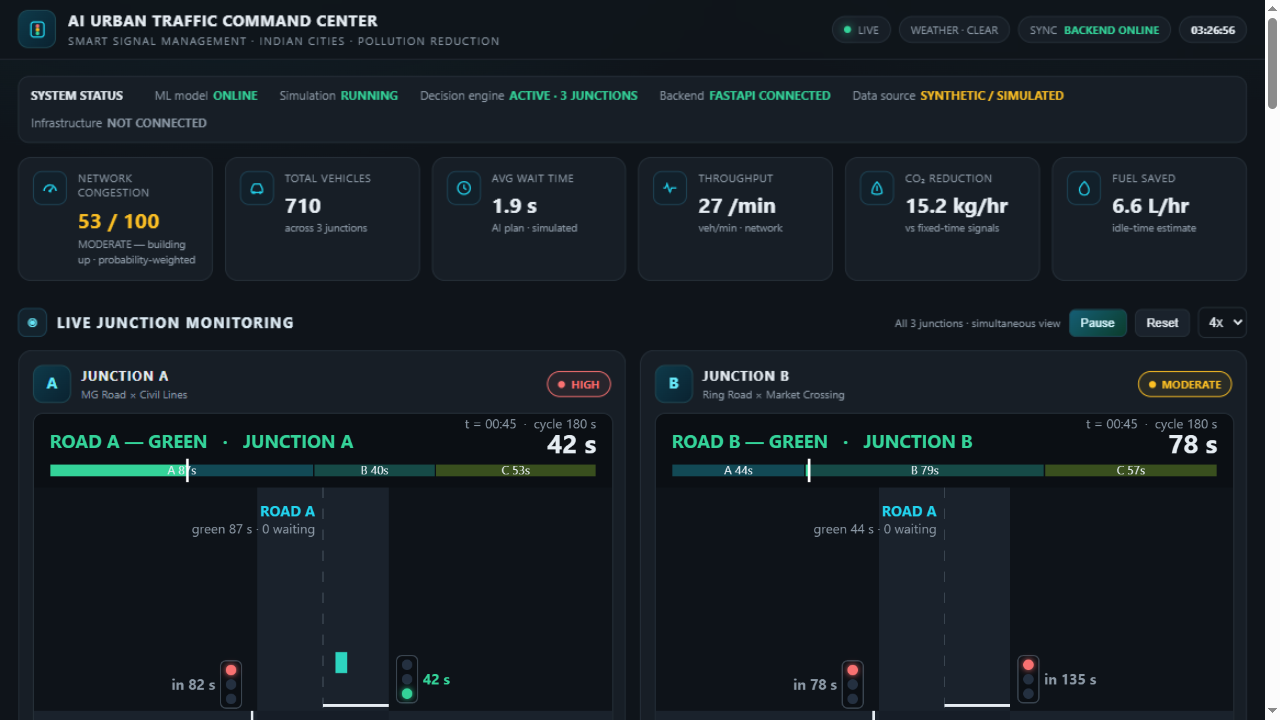
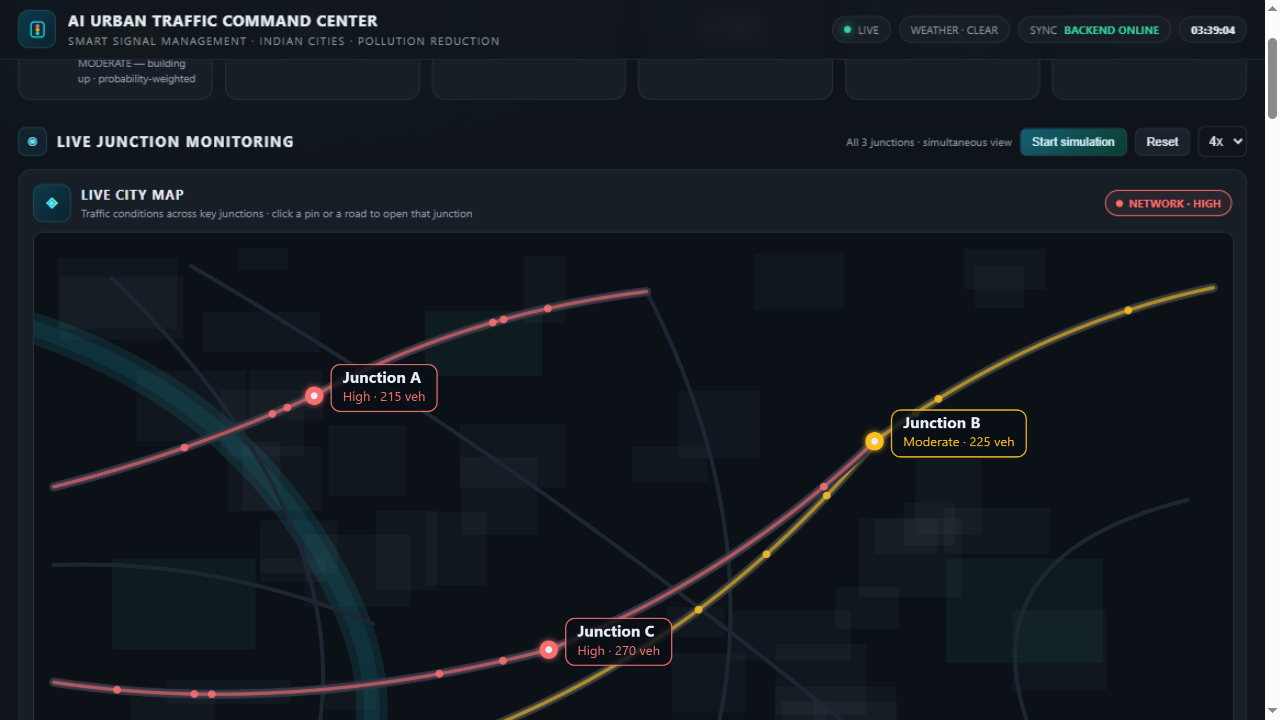
- Multi-junction command center for three simulated urban junctions
- Random Forest congestion classification with Low, Moderate, and High classes and prediction probabilities
- Short-horizon traffic-demand forecasting
- Adaptive green-time recommendations constrained to 20–90 seconds with an exact 180-second cycle
- Digital-twin-style simulation of arrivals, queues, signal states, vehicle movement, delay, throughput, and idle time
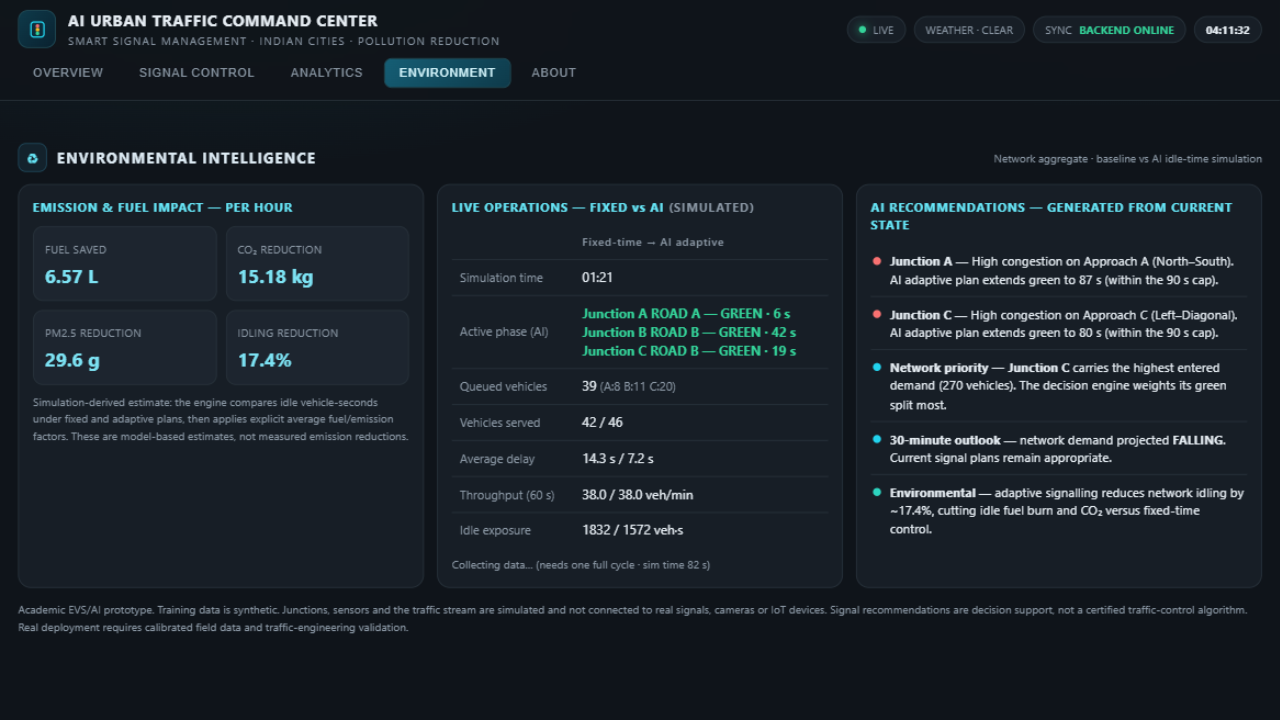
- Fixed-time versus AI-assisted strategy comparison under the same simulated conditions
- Model-based fuel, CO₂, and PM2.5 estimates derived from simulation outputs
- Simulated environmental signals and bounded manual signal overrides
TECHNOLOGY
ARCHITECTURE
Simulated traffic inputs → feature preparation → Random Forest congestion classifier and demand forecaster → constraint-aware signal optimizer → traffic simulation → environmental estimates → command-center dashboard.
IMPLEMENTATION
The system separates model predictions from signal recommendations. A bounded optimization layer applies the 20–90 second green-phase limits and exact 180-second cycle before recommendations are evaluated in a queue-based simulation. The dashboard presents the prediction, forecast, signal plan, simulation comparison, and environmental interpretation as one workflow.
OUTCOMES & NOTES
The repository documents an end-to-end prototype that connects ML prediction to constrained signal planning and simulation-based evaluation. Add measured experiment results here only after confirming them from the project outputs; no real-world congestion reduction or emissions reduction is claimed.
Academic prototype using synthetic/simulated traffic data. It does not control real traffic signals, connect to municipal infrastructure, or measure real-world emissions. Environmental values are model-based estimates, not direct sensor measurements.
NEXT / SELECTED WORK
Keep exploring.
02 / SELECTED WORK
Ideas made
tangible.
A selection of explorations across learning, audio analysis, workforce data and urban systems.